

Choose one observable learning need
Use a defined sample of recurring questions to identify the task staff struggle to perform. It may be recognizing a missing handoff, selecting the right response owner or interpreting a system status.
State what a trained person should do differently. Avoid using a payer outcome alone as evidence that a staff member needs training; first check the process, source information and decisions outside that person’s authority.
Find the right instruction owner
A practice manager can approve an administrative route, while clinical and coding topics need appropriately qualified review. Identify who maintains the instruction and which current source applies.
CMS E/M and NCCI resources are relevant for particular Medicare review, but a short training exercise should not turn them into universal code or modifier rules. Keep the scope and effective reference clear in the approved material.

Move from the question to the next action
Teach with a realistic fictional example
Create an example that includes the information staff would actually see and the decision they are authorized to make. Include a missing-information or escalation case as well as a normal handoff.
Avoid distributing identifiable records for convenience. Ask the learner to identify the next task and explain why it belongs with that owner, rather than memorize a slogan that does not help when an exception occurs.
Put the instruction where work happens
Update the approved checklist or workflow reference used by the team. A presentation in an archive does not help if staff still rely on an obsolete desk note.
Identify how changes will be communicated and which prior instruction is replaced. Keep the resulting guidance short enough to follow, with a clear escalation route for circumstances it does not cover.
Review adoption without overstating results
At a later check, sample whether the intended handoff occurred and whether staff used the right source or recipient. Separate this process observation from reimbursement outcomes.
The primary care checklist can track anonymous training follow-up tasks, including an owner and review date. If the change is not used, investigate whether the instruction, access or workload prevents adoption before simply repeating the same training session.
Illustrative workflow
A practical example.
Fictional workflow: staff repeatedly forward payer questions to the clinician even when the missing detail belongs to enrollment. The practice creates a fictional response-routing exercise and an approved owner reference. A later sample checks whether the questions reach the appropriate contact. The review records adoption of the routing process and preserves any remaining policy question for qualified review.
Put it into practice
- Define the task staff should perform differently.
- Use an approved instruction and fictional exceptions.
- Check later adoption with the same observable task.
Inside the workbook
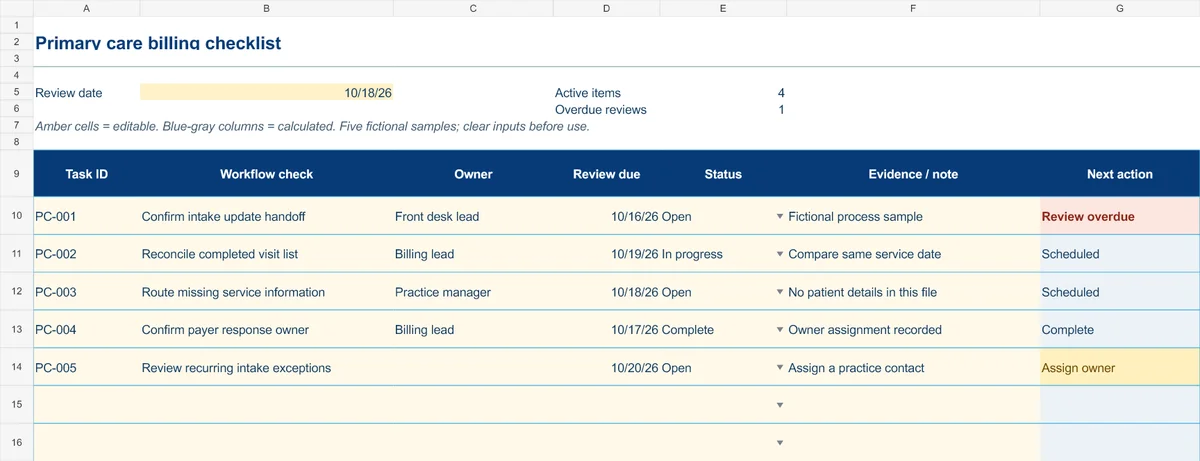
Start with the Instructions tab. Replace the five fictional samples, set your review date and keep the formula columns intact.
Free XLSX tool · No signup
Primary care billing checklist
Daily process checks across intake, encounter reconciliation and payer follow-up.
- 50 prepared task rows and five fictional examples
- Owner, review date, status and evidence notes
- Calculated next-action reminders
Use anonymous process tasks. Keep PHI in approved systems. Includes instructions and fictional samples; no macros or live data connection.