

Choose a question the review can answer
Replace a broad concern such as “billing is not working” with a concrete question: why visit records do not reach charge entry, why a payer response repeats or why two reports disagree. State the population, period and workflow boundaries. This makes evidence collection proportionate and helps distinguish a process review from a clinical, coding or legal determination requiring an appropriately qualified reviewer.
Preserve reproducible evidence
Keep the report name, run date, filters and data source with the sample. When a finding depends on a payer response, retain its reference and the relevant service date in the approved system.
Agree on access and secure exchange before sharing records. A public business inquiry can describe the problem without patient or claim details; the detailed review can be scoped through an appropriate channel afterward.

Move from the question to the next action
Map the exception path
Write down what staff actually do when information is missing or a decision is delayed. Include informal messages, repeat checks and handoffs that are absent from the official procedure.
Ask where ownership becomes unclear and what evidence the receiving person needs. The most useful observation may be a missing approval or a report-definition difference rather than an error in the individual claim being reviewed.
Record correction and prevention separately
For each finding, describe the source evidence, affected process, immediate action and proposed process change. Identify the person authorized to approve each action.
A one-time correction does not automatically repair the workflow, and a new checklist does not resolve every item already affected. Keeping these tasks separate lets the practice assign realistic owners and see what has actually been completed.
Define a proportionate follow-up
Agree on what will be reviewed after a change: a later sample, an exception queue or the same report with the same filters. Do not promise a result from a small sample or an untested procedure.
If the question involves Medicare coverage, consult the applicable CMS coverage references and effective versions. Keep operational conclusions within the evidence reviewed and route clinical or coding conclusions to the appropriate decision maker.
Illustrative workflow
A practical example.
Fictional workflow: a practice believes a location’s open balances rose after a staffing change. The review first discovers that the new report includes another payer group. The team preserves a comparable report definition, then samples the remaining exceptions. Two distinct actions result: correct the reporting comparison and clarify who answers missing-information requests. Neither finding is treated as proof about every claim or the performance of an individual employee.
Put it into practice
- Define the question and sample boundaries.
- Preserve report settings and source references.
- Assign an approval owner and a follow-up method.
Inside the workbook
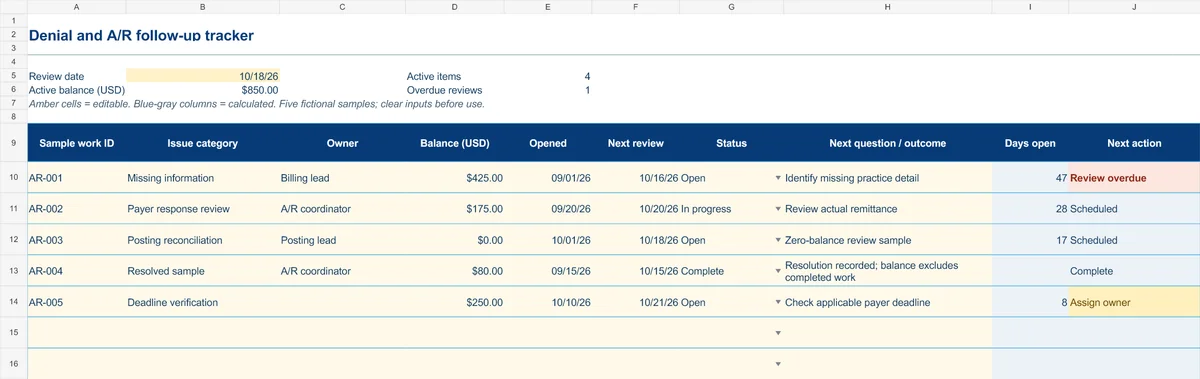
Start with the Instructions tab. Replace the five fictional samples, set your review date and keep the formula columns intact.
Free XLSX tool · No signup
Denial & A/R follow-up tracker
Plan anonymous follow-up work and make overdue reviews and missing owners visible.
- Fictional USD balances and active-balance summary
- Review dates chosen by your practice
- Calculated active items, age and next actions
Use anonymous process tasks. Keep PHI in approved systems. Includes instructions and fictional samples; no macros or live data connection.