
Separate program identity from a general payer label
Begin with the actual product and workflow in the approved practice records. NC Medicaid identifies NCTracks as an online enrollment route and provides credentialing and recredentialing resources.
That program source does not answer every plan-specific claim or authorization question. Keep the relevant program and plan contacts distinguishable, and use Medicare enrollment references separately when the project concerns Medicare.
Map the question to the right function
Enrollment, eligibility research, authorization coordination and claim follow-up may use different channels and require different evidence. A single general contact list hides those distinctions.
For each recurring question type, identify where staff find current instructions and who confirms applicability. Keep access credentials and patient-specific references out of the general routing map and in the practice’s approved systems.

Move from the question to the next action
Record source maintenance responsibility
Name the person who reviews a changed notice or route and approves updates to the staff reference. Preserve the official source and review date so another team member can verify it.
Do not embed an old policy excerpt without a version or assume that a familiar portal screen proves the same process applies to every product. Mark uncertain routes as needing confirmation with a specific next question.
Test a handoff across teams
Use a fictional provider change, an authorization-information request and a claim-status question. Ask staff to identify the source and owner for each, then check whether the recipient can continue the work.
The test should reveal unclear roles before the routing map is treated as authoritative. Clinical and coding questions still belong with the appropriately qualified reviewers rather than whichever administrative team receives the first message.
Scope support around the maintained map
The free register can track anonymous route-review projects and next actions. It does not provide portal access or determine program eligibility.
Charlotte practices can discuss their products, systems and support needs with Jacksonville-based SBS to confirm a possible remote arrangement. This guide offers an educational planning method and does not claim an SBS Charlotte office or a North Carolina payer relationship.
Illustrative workflow
A practical example.
Fictional Charlotte workflow: a team sends a provider update and a claim question through the same informal route. The manager checks the relevant official program source, separates the functions and assigns a maintenance owner for the routing reference. A fictional test confirms that staff can identify the correct next recipient. Sensitive records and account access remain within approved systems.
Put it into practice
- Distinguish North Carolina program and plan functions.
- Give every route a current source and maintenance owner.
- Test the map with different kinds of questions.
Inside the workbook
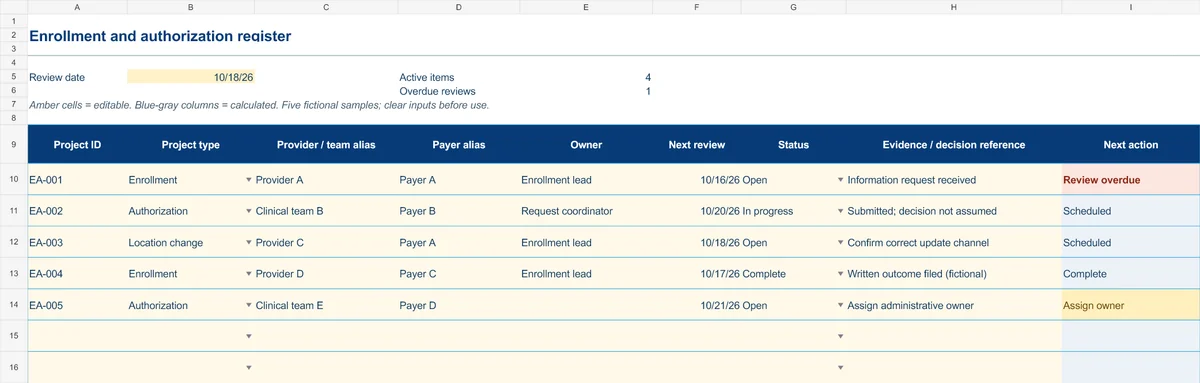
Start with the Instructions tab. Replace the five fictional samples, set your review date and keep the formula columns intact.
Free XLSX tool · No signup
Enrollment & authorization register
Track administrative projects from information gathering to a documented outcome.
- Project-type and status dropdowns
- Provider/team aliases and outcome references
- Calculated reminders for ownership and reviews
Use anonymous process tasks. Keep PHI in approved systems. Includes instructions and fictional samples; no macros or live data connection.