

Choose the work you want supported
Describe a specific queue or process: payer follow-up, intake-to-billing questions, reporting reconciliation or administrative coordination. Identify the provider, location and product scope in the approved records.
A support arrangement is easier to assess when both parties understand the starting population and the work that remains with the practice. Avoid assuming that a broad revenue-cycle label includes every clinical, coding or financial decision.
Clarify the practice response obligations
Remote coordination depends on a named practice contact who can supply missing facts and arrange authorized review. Define how questions reach that person and what happens when the response requires a clinician, coder or manager.
A support partner cannot resolve an unavailable practice decision by working the same item repeatedly. Keep the dependency and next review visible so the operating plan reflects the work each party can actually perform.

Move from the question to the next action
Review systems and record handling
Identify the approved systems, source reports and access needed for the agreed tasks. Where protected health information is involved, address the applicable arrangements and safeguards for the actual scope. HHS business-associate guidance is a relevant reference.
Initial public inquiries should remain business-only; detailed records follow the approved secure process. A free spreadsheet is a planning aid, not a substitute for access controls or record-handling arrangements.
Separate program requirements from vendor scope
A Texas program enrollment or payer-policy question should be checked through the actual official route, such as the relevant TMHP resources for Texas program work. The support contract does not itself establish enrollment, authorization or payment eligibility.
Preserve the source and decision owner for any requirement affecting the workflow. Do not assume a process used by another practice or state is appropriate for the current product and service.
Agree a bounded transition and review
Test a defined workflow with the appropriate access and approvals, then review whether questions and outcomes reach the correct records. Use the internal medicine tracker for anonymous transition tasks and next actions.
Practices in Dallas–Fort Worth can discuss remote support with Jacksonville-based SBS to confirm fit and responsibilities. No separate DFW office or local client history is represented; the working arrangement must follow the actual agreed scope.
Illustrative workflow
A practical example.
Fictional DFW workflow: a practice asks for remote follow-up help but has not named the person who answers missing-information requests. The scoping discussion identifies that role, defines the approved records and tests an exception handoff. The transition plan then separates the partner’s research task from the practice’s authorized decision, with a review method for unresolved dependencies.
Put it into practice
- Define the starting work and retained practice decisions.
- Approve access and secure information exchange.
- Test a bounded transition before expanding scope.
Inside the workbook
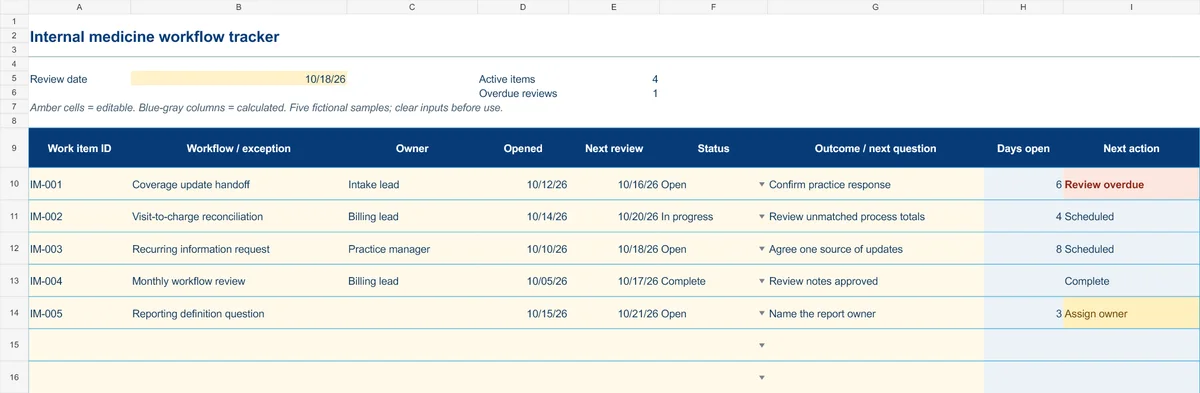
Start with the Instructions tab. Replace the five fictional samples, set your review date and keep the formula columns intact.
Free XLSX tool · No signup
Internal medicine workflow tracker
Coordinate recurring administrative exceptions, responsibilities and follow-up.
- 50 prepared operational work-item rows
- Opened date, next review and outcome notes
- Calculated days open and next actions
Use anonymous process tasks. Keep PHI in approved systems. Includes instructions and fictional samples; no macros or live data connection.