

Build a provider–entity–location map
Identify the actual clinicians, organizations, locations and planned services in the approved records. Keep the relationship between these facts visible before creating a consolidated work queue.
A central dashboard should not hide which entity or location owns an unresolved question. Assign one practice owner to confirm the source facts and approve changes so parallel projects do not proceed from inconsistent versions.
Separate the program and payer routes
Create an applicability map for the products and services actually involved. Medicare enrollment and coverage references have their own scope; state program sources in Georgia, North Carolina and Texas provide different operational starting points.
Do not assume one application or portal route updates every relationship. Keep each route’s source and responsible reviewer visible, and mark unresolved applicability questions rather than filling them with a copied rule.

Move from the question to the next action
Define central and local responsibilities
Identify which tasks a central team can coordinate and which require a location-specific contact or qualified reviewer. A missing administrative field, clinical clarification and payer determination may have different owners.
Keep patient-level records in approved systems and use aliases for broad operational planning. When work moves between teams, record the exact question and recipient instead of transferring an unexplained balance or broad “pending” status.
Make launch readiness evidence-based
For each defined milestone, preserve the actual submission, outcome or approved procedure. Receipt is not the same as a confirmed participation fact, and a functioning software connection does not establish billing eligibility.
Test normal and exception handoffs with fictional scenarios, then confirm the approved scope for any real records. Clinical decisions, coding review and program determinations remain with their appropriate authorized owners.
Launch in a controlled, reviewable sequence
Choose a bounded initial workflow and a method for checking whether information and decisions reach the correct teams. Keep report definitions stable across locations before comparing results.
The free enrollment and authorization register can coordinate anonymous readiness tasks. Discuss the actual states, products, systems and service needs with Jacksonville-based SBS when assessing remote support; do not assume a national footprint or automatic service acceptance from this educational guide.
Illustrative workflow
A practical example.
Fictional workflow: a group plans two new markets using one shared project checklist. The review identifies different program routes and assigns a source owner for each. The central team coordinates milestones, while local contacts answer location facts and qualified reviewers handle service questions. The first workflow is tested before expansion, and unresolved enrollment or participation questions remain visible instead of being absorbed into a single launch date.
Put it into practice
- Map actual providers, entities, locations and services.
- Track payer and program applicability separately.
- Use evidenced milestones and test exception handoffs.
Inside the workbook
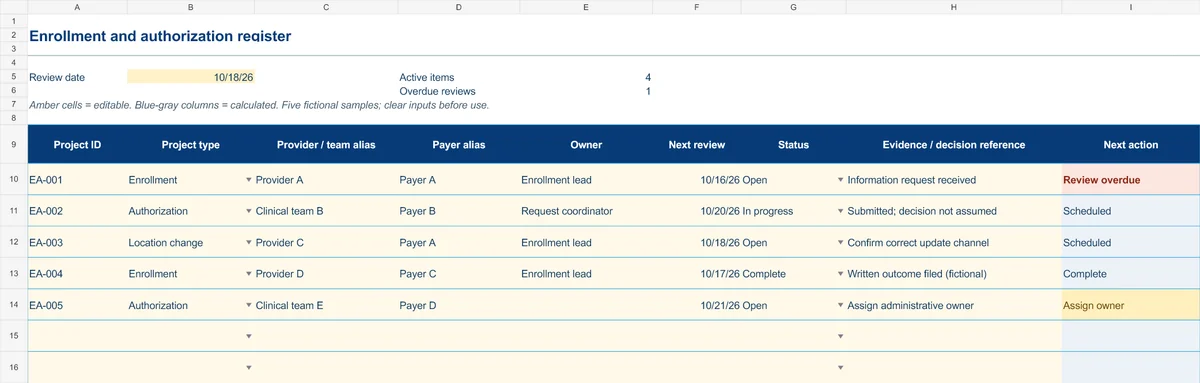
Start with the Instructions tab. Replace the five fictional samples, set your review date and keep the formula columns intact.
Free XLSX tool · No signup
Enrollment & authorization register
Track administrative projects from information gathering to a documented outcome.
- Project-type and status dropdowns
- Provider/team aliases and outcome references
- Calculated reminders for ownership and reviews
Use anonymous process tasks. Keep PHI in approved systems. Includes instructions and fictional samples; no macros or live data connection.