

Confirm the provider information in scope
Identify the clinician, practice entity, relevant location and payer product in the authorized records. A provider’s general identifier does not answer every participation or service-specific question.
When enrollment or contracting status is uncertain, preserve the actual correspondence and seek the applicable written confirmation. Avoid allowing a scheduling assumption to become the billing team’s only evidence for the provider’s status.
Keep the visit record attached to the service question
The handoff should show which documented service is under review and where the authorized reviewer can find the supporting record. Scheduling descriptions and informal shorthand may not represent the documented encounter. Administrative staff can check that the record reached the correct queue and ask for a missing detail; clinical documentation and coding decisions remain with the appropriate professionals and approved practice process.

Move from the question to the next action
Check the payer and delivery context
A billing question may depend on the actual payer product, setting or mode of service. Do not carry a rule from an unrelated plan or earlier period into a new decision without review.
CMS coverage resources help locate Medicare documents where relevant, but they are not a substitute for checking applicability. Preserve the source and effective version used by the qualified reviewer so a later question can be investigated accurately.
Route payer responses to a specific decision
When a claim response raises a provider or service question, record what the payer communicated and who can answer it. A general “provider issue” label may conceal a data mismatch, participation question or separate service requirement.
Keep the next task narrow and prevent unnecessary repeat requests to the clinician when the missing fact belongs with enrollment or practice administration. Track the handoff until the recipient confirms the outcome.
Use recurring questions for process education
Review repeated exceptions with practice leadership and appropriately qualified reviewers. The useful training topic may be how staff identify the correct provider record or how a visit reaches billing, rather than a universal instruction about a code or modifier.
The primary care process checklist can be adapted for anonymous administrative checks, but it should not contain counseling records, diagnoses or patient identifiers. Preserve sensitive detail in the practice’s approved systems.
Illustrative workflow
A practical example.
Fictional workflow: a billing response is labelled “provider.” The coordinator checks the actual message and identifies an enrollment-detail question, not a request to change the clinical record. The enrollment owner confirms the relevant fact and communicates the outcome to billing. The team then updates its onboarding handoff so the same information is available when a new provider’s visit workflow begins.
Put it into practice
- Identify the provider, entity, location and payer product.
- Use the actual visit record and qualified review.
- Route participation questions separately from clinical questions.
Inside the workbook
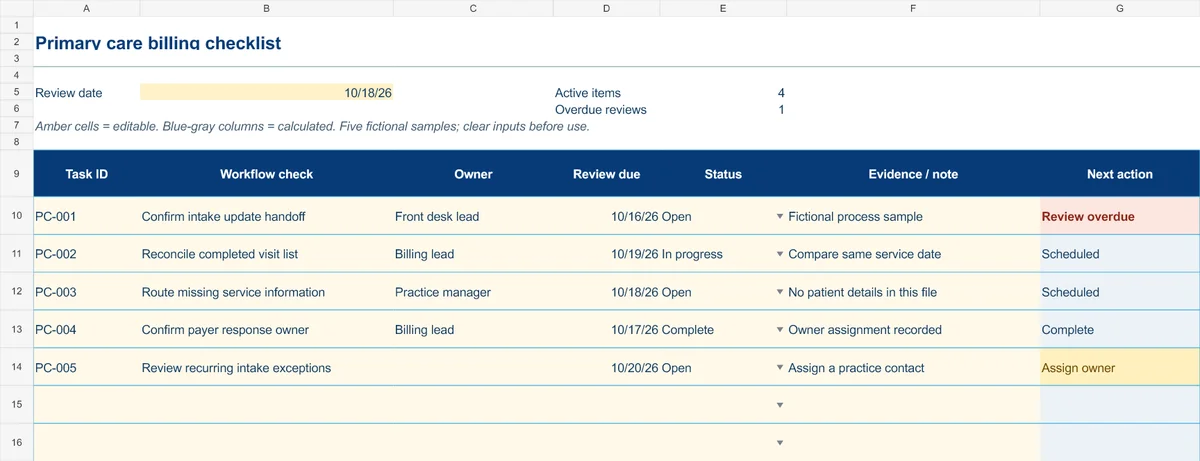
Start with the Instructions tab. Replace the five fictional samples, set your review date and keep the formula columns intact.
Free XLSX tool · No signup
Primary care billing checklist
Daily process checks across intake, encounter reconciliation and payer follow-up.
- 50 prepared task rows and five fictional examples
- Owner, review date, status and evidence notes
- Calculated next-action reminders
Use anonymous process tasks. Keep PHI in approved systems. Includes instructions and fictional samples; no macros or live data connection.