

Start with the day’s operational population
Agree on the visit list or other approved source the team will use for reconciliation. Keep the date, location and provider scope clear.
A completed appointment, a documented service and a submitted claim are different events, so the checklist should name which event it verifies. Avoid measuring completion from whichever report is easiest to obtain when that report represents a different stage.
Confirm the intake update route
Decide how corrected coverage, demographic or provider information reaches the people preparing claims. Name the contact who can answer questions when the original update is incomplete.
The checklist should ask whether the handoff occurred, not invite staff to copy identifying information into an unrestricted spreadsheet. When the same question repeats, record the process issue for review instead of adding more personal messages to the chain.

Move from the question to the next action
Reconcile encounters and unresolved questions
Compare the agreed visit population with the billing workflow using the practice’s approved process. Separate unready records from items already submitted and items that need a clinical or coding decision.
Administrative staff can track the missing question and responsible reviewer; they should not manufacture documentation or choose a service level to make a queue look complete. CMS maintains Medicare E/M guidance for qualified review when applicable.
Review payer responses as work items
A daily check can confirm that new responses have an owner and a next action. It should not demand that every response be resolved immediately. Keep true receipt, adjudication and payment milestones distinct in the account system.
For matters waiting on another team, document the requested decision and review date. This helps the next shift continue the work without guessing what “pending” means.
Keep the checklist short enough to use
The free primary care workbook includes task ID, workflow check, owner, review due date, status, evidence note and calculated next action. Begin with the actual recurring checks your team owns. Remove irrelevant sample inputs, keep formulas intact and use nonpatient aliases.
At a weekly review, ask which checks identify useful exceptions and which merely repeat information already visible elsewhere. Revise the process deliberately rather than adding a new checkbox after every isolated problem.
Illustrative workflow
A practical example.
Fictional workflow: reception corrects an intake detail after the initial handoff. The coordinator marks the update-routing check open, assigns the front desk lead and sets the next review. The billing team confirms receipt in the approved system. The checklist then records that the process check is complete, while all patient-specific detail remains in the authorized practice records.
Put it into practice
- Name the source population and reconciliation stage.
- Assign one owner to each unresolved handoff.
- Use the workbook for process checks, not patient records.
Inside the workbook
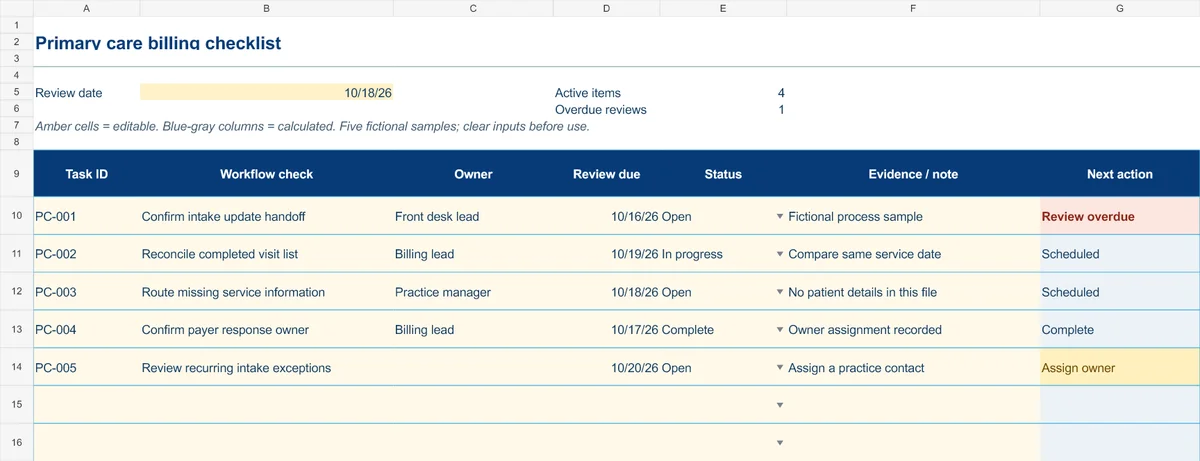
Start with the Instructions tab. Replace the five fictional samples, set your review date and keep the formula columns intact.
Free XLSX tool · No signup
Primary care billing checklist
Daily process checks across intake, encounter reconciliation and payer follow-up.
- 50 prepared task rows and five fictional examples
- Owner, review date, status and evidence notes
- Calculated next-action reminders
Use anonymous process tasks. Keep PHI in approved systems. Includes instructions and fictional samples; no macros or live data connection.