

Define which encounter list you are reconciling
Use a named source population with a clear service period, location and provider scope. Confirm whether it includes cancelled, rescheduled or otherwise incomplete appointments.
The person doing reconciliation should know which statuses belong in the comparison and how exceptions are handled. A count mismatch can be meaningful only when both sides of the comparison describe the same set of operational events.
Compare stages rather than totals alone
Match the visit population with the relevant documentation and charge workflow in the authorized system. Identify whether an unmatched item is awaiting completion, review, transmission or another defined step.
Do not assume that a missing submitted claim means missing revenue; the encounter may not be ready or may have a legitimate different disposition. Record the specific status so the next task addresses the real gap.

Move from the question to the next action
Assign an exception route
Use separate response owners for intake questions, documentation availability and qualified coding review. A reconciliation coordinator can identify an unmatched encounter without being authorized to resolve every clinical or billing decision.
Make the requested information explicit and preserve the dependency until it is answered. If an item belongs outside the original population, document the reason through the approved process instead of silently removing it to force totals to agree.
Keep corrections traceable
When an exception is resolved, record the action and responsible reviewer in the appropriate source system. Preserve enough history to explain a later count difference.
Reconciliation should help detect duplicate work as well as omissions, so confirm the current status before creating another task or resubmitting anything. CMS E/M resources are relevant when a Medicare visit requires qualified documentation or coding review; an encounter count cannot establish the correct service level.
Report the unresolved portion clearly
At closeout, describe the reconciled population, the outstanding categories and the questions awaiting practice action. Separate items resolved through source-list corrections from items that progressed to another billing stage.
The primary care checklist can track ownership of this daily process without storing patient detail. Use later samples to see whether an intake or documentation handoff change reduced the same exceptions, and keep the comparison definition stable.
Illustrative workflow
A practical example.
Fictional workflow: the completed-visit report and the charge queue disagree. The first comparison reveals that one source includes cancelled appointments. After aligning the population, the remaining unmatched items are split between documentation review and an intake question. Each group receives a named owner. The final reconciliation explains the original definition difference and the genuine pending work instead of treating the entire mismatch as unbilled services.
Put it into practice
- Align service dates, locations and encounter statuses.
- Investigate unmatched records before creating work.
- Separate population corrections from billing-stage progress.
Inside the workbook
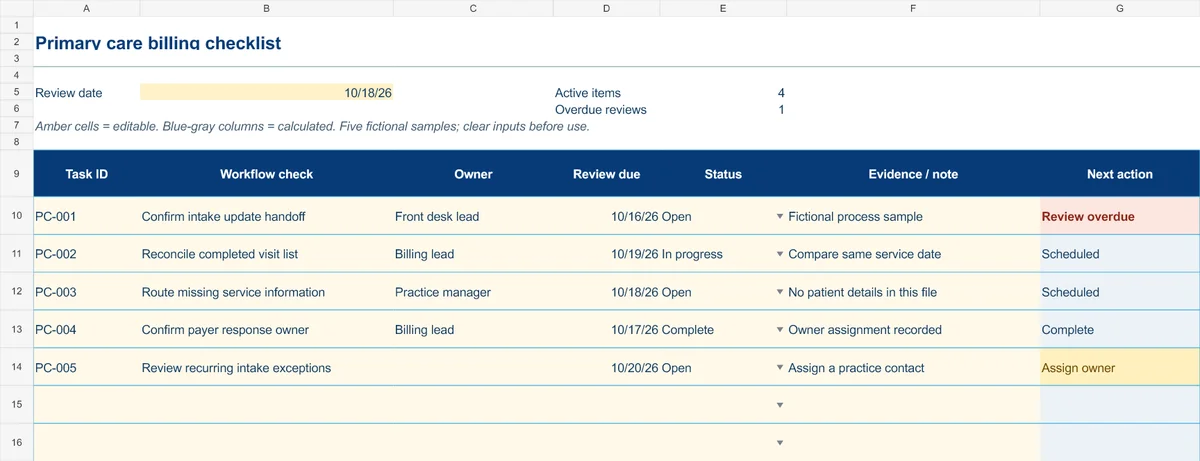
Start with the Instructions tab. Replace the five fictional samples, set your review date and keep the formula columns intact.
Free XLSX tool · No signup
Primary care billing checklist
Daily process checks across intake, encounter reconciliation and payer follow-up.
- 50 prepared task rows and five fictional examples
- Owner, review date, status and evidence notes
- Calculated next-action reminders
Use anonymous process tasks. Keep PHI in approved systems. Includes instructions and fictional samples; no macros or live data connection.