

Do not let the appointment label decide the claim
Scheduling labels help organize a calendar, but they do not establish every service performed or the appropriate coding. Agree on the source the billing team uses and how it knows the record is ready for review.
A visit that begins with one purpose may require additional documented work. The administrative process should make that difference visible without asking reception to decide what is separately reportable.
Frame the question for the clinician or coder
When the record and proposed charges do not align, describe the specific gap. Ask which documented service supports the proposed charge or which decision needs qualified review.
Avoid vague requests to “add something for billing.” Documentation should reflect the care provided, and any clarification should follow the practice’s approved process. The reviewer needs the relevant record context and applicable payer guidance, not a suggested outcome designed to increase payment.

Move from the question to the next action
Use current rules within their actual scope
CMS publishes Medicare E/M guidance and NCCI information. Those resources help a qualified reviewer locate the relevant Medicare framework; they do not turn a general article into a coding decision for every commercial product.
Check the applicable service date, payer and current edit or policy. Do not assume that a modifier permits separate payment simply because it was accepted on an unrelated visit in the past.
Keep the pending decision visible
Create an administrative hold or review task that states what is unanswered, who reviews it and when billing will check again. Preserve the original proposed charge and the authorized outcome in the proper record.
If a clarification changes the next action, communicate that change to the staff member preparing the claim. A queue marked “waiting on provider” is only useful when the provider’s actual question is clear.
Teach the pattern without distributing records
After several similar questions, a clinician and qualified coding reviewer can identify the workflow issue for team education. Use approved, appropriately handled examples and focus training on the distinction staff need to recognize.
The checklist should confirm that uncertain visit combinations reach review; it should not contain a universal code pair, promised payment or automatic rule. Keep this education separate from patient-specific coding determinations and document the approved process.
Illustrative workflow
A practical example.
Fictional workflow: an appointment is marked as a preventive visit, while the completed record raises a question about additional work. The billing coordinator records the exact review question and sends it to the designated clinician and coder. The claim follows the approved outcome after review. The team later updates its handoff instruction so future records with the same type of uncertainty reach the same reviewers.
Put it into practice
- Use documented services rather than scheduling labels.
- Route coding and modifier questions to qualified review.
- Record the authorized decision and its supporting reference.
Inside the workbook
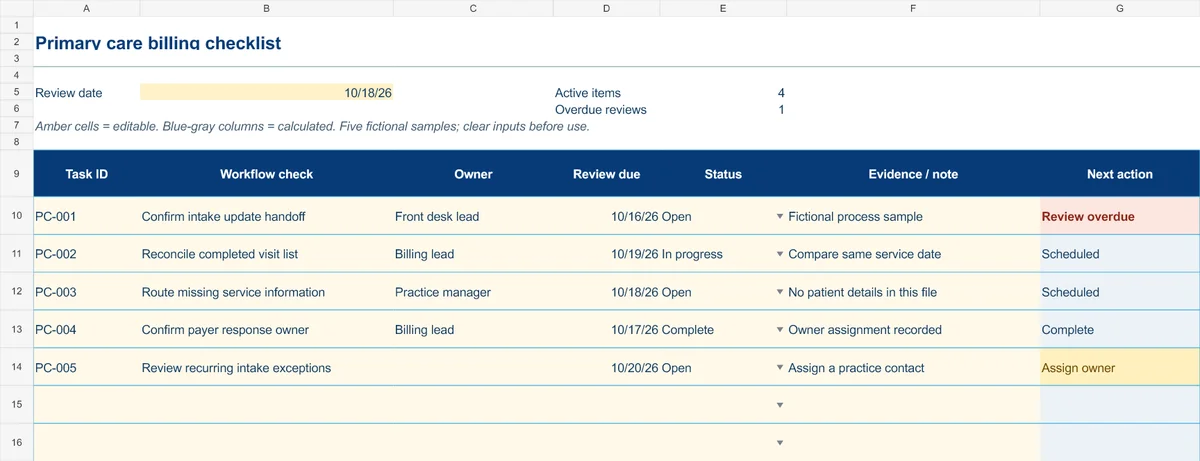
Start with the Instructions tab. Replace the five fictional samples, set your review date and keep the formula columns intact.
Free XLSX tool · No signup
Primary care billing checklist
Daily process checks across intake, encounter reconciliation and payer follow-up.
- 50 prepared task rows and five fictional examples
- Owner, review date, status and evidence notes
- Calculated next-action reminders
Use anonymous process tasks. Keep PHI in approved systems. Includes instructions and fictional samples; no macros or live data connection.