

Choose a useful unit of investigation
Define whether a row represents one recurring workflow question, a payer-response group or an improvement project. Mixing these units makes counts misleading.
Use a stable project ID and state the population and period being examined. Keep the detailed claims in approved systems; the process log can summarize the issue using aliases and point to the authorized source rather than collecting another copy of sensitive records.
Separate the observed reason from the proposed cause
Record what the response actually says before writing an explanation of why it happened. A missing-information response is an observation; an assumption that intake failed is a hypothesis until the handoff is traced.
Preserve both fields if needed and name who will investigate. This allows the team to revise its explanation when evidence shows that the information existed but was routed incorrectly.

Move from the question to the next action
Map the evidence through the workflow
Review the relevant source at intake, documentation, claim preparation and response. Ask which team had the information, what it was expected to do and whether the next person received it.
The goal is a reproducible explanation rather than a collection of anecdotes. Use the actual payer response and applicable guidance for individual decisions; a process hypothesis should not decide a correction or appeal by itself.
Design an observable improvement
Write the action as a concrete change with an owner: designate one response contact, clarify a field instruction or add a receipt confirmation. Define what later evidence would show adoption and what would remain uncertain.
Avoid broad instructions such as “reduce denials” as the action itself. A team can perform an agreed handoff improvement even though the eventual payment outcome depends on additional factors.
Review and retain the finding
At the next review, use the same population definition and describe what the sample showed. If the expected change did not occur, identify the remaining barrier and adjust the task.
Preserve the original observation and subsequent decisions rather than overwriting the history. The free denial and A/R workbook can assign operational investigation tasks; add source references only through approved systems and do not use it as a patient-level denial database.
Illustrative workflow
A practical example.
Fictional workflow: a recurring issue is initially attributed to missing intake data. The investigation finds that the data exists but the billing query has no designated recipient. The approved change names a response role and backup. The follow-up sample checks whether the queries reached that role and received answers. The log records the revised explanation rather than preserving the original assumption as a proven cause.
Put it into practice
- State what each log row represents.
- Separate the observed response from a cause hypothesis.
- Test a concrete change with comparable evidence.
Inside the workbook
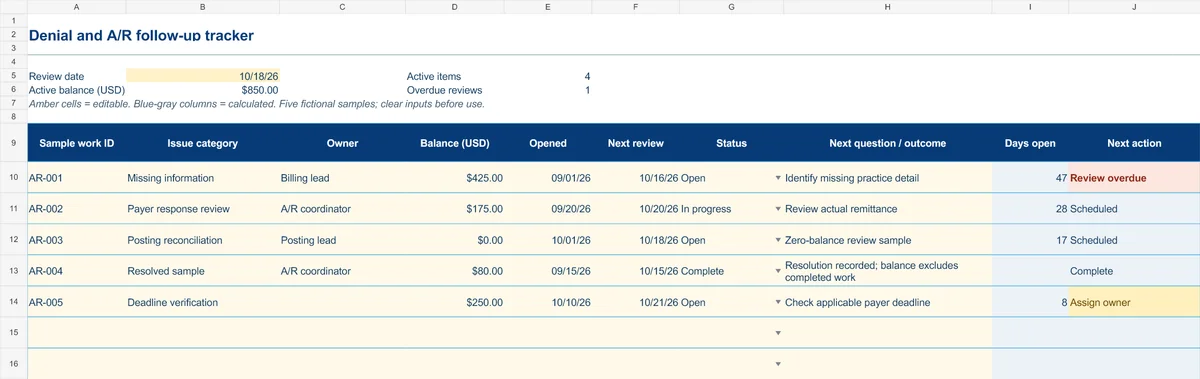
Start with the Instructions tab. Replace the five fictional samples, set your review date and keep the formula columns intact.
Free XLSX tool · No signup
Denial & A/R follow-up tracker
Plan anonymous follow-up work and make overdue reviews and missing owners visible.
- Fictional USD balances and active-balance summary
- Review dates chosen by your practice
- Calculated active items, age and next actions
Use anonymous process tasks. Keep PHI in approved systems. Includes instructions and fictional samples; no macros or live data connection.