

Build a comparable group
Start from actual responses and a defined review period. Group by the relevant payer product, service workflow or stated reason, and check that apparently similar items really share the same question.
A broad internal label can combine missing information with coding or coverage issues. Keep the source references available in approved systems so the review can return to the evidence rather than rely on a summary category alone.
Test the handoff before naming a cause
Follow a small, purposeful sample through intake, documentation review, claim preparation and payer response. Ask what information was available at each step and who could act on it.
Avoid describing a staff error or payer pattern before the evidence supports that conclusion. The recurring issue may arise because the right detail was recorded but never reached the next team, rather than because the detail was absent.

Move from the question to the next action
Protect individual decisions and deadlines
An improvement investigation does not pause the applicable work on affected claims. Keep each decision route, source deadline and authorized reviewer visible. If a question concerns coverage or coding, use the relevant payer material and qualified review.
CMS coverage resources can help locate Medicare documents, but a document’s applicability and effective version still need checking. Do not use a repeated denial as a reason to alter clinical records to match a desired outcome.
Design a change that addresses the evidence
Write the proposed change as an observable action: a named update route, a required review handoff or a clarified response owner. Avoid a general instruction to “be more careful.” Decide who approves the change and which later records will show whether it was followed. Keep the change proportionate to the sample, and document any unanswered question that would limit a broader conclusion.
Review recurrence using the same definition
Compare the next review with the original population and reason definition. A lower count may reflect fewer reviewed items or a category change, so preserve the denominator and context.
The internal medicine tracker can assign the investigation and follow-up tasks while the detailed claims remain in approved systems. Report what the team observed, what it changed and what remains uncertain instead of promising the elimination of denials.
Illustrative workflow
A practical example.
Fictional workflow: a repeated category appears to be one documentation problem. Sampling shows two distinct causes: unanswered practice queries and a separate payer-policy question. The manager creates one handoff improvement and one qualified policy review. Individual items continue through their applicable follow-up routes. At the next review, the team uses the same grouping to see which issue still recurs.
Put it into practice
- Confirm that grouped responses share a real question.
- Keep claim-level actions active during process review.
- Measure recurrence with a stable population definition.
Inside the workbook
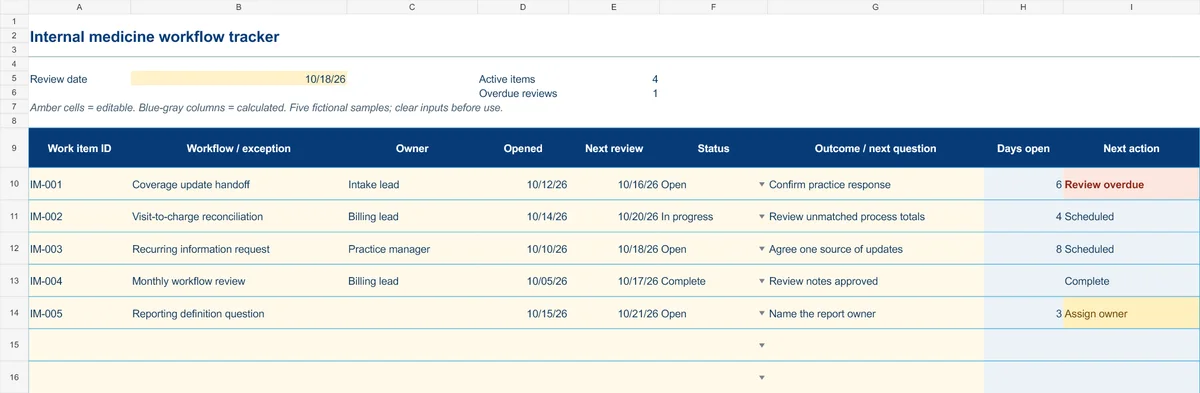
Start with the Instructions tab. Replace the five fictional samples, set your review date and keep the formula columns intact.
Free XLSX tool · No signup
Internal medicine workflow tracker
Coordinate recurring administrative exceptions, responsibilities and follow-up.
- 50 prepared operational work-item rows
- Opened date, next review and outcome notes
- Calculated days open and next actions
Use anonymous process tasks. Keep PHI in approved systems. Includes instructions and fictional samples; no macros or live data connection.