

Draw the route of the information
Begin with the practice’s actual visit and testing processes. Identify where service information originates, who reviews it and how it reaches billing. Include outside results or services only to the extent needed to clarify responsibility.
A record appearing in the chart does not establish that the practice performed or bills every related service. The operational map should expose that question early rather than leave it for an unpaid-balance investigation.
Keep the service reference specific
When information is missing, name the record or administrative fact required and where the authorized reviewer can find the supporting source. A request such as “review testing” is difficult to route.
Specify whether the question concerns the service performed, the organization involved or the availability of documentation. Preserve patient-level references in the approved system while an operational tracker can summarize the process task using an alias.

Move from the question to the next action
Separate a clinical question from payment research
The person following up with a payer may need a practice response, but the payer conversation does not authorize a change to the clinical record. Route clinical clarification and coding questions to the appropriate reviewers.
Separately record what the payer communicated and what evidence it requested. This keeps the clinician from receiving a broad payment problem that cannot be answered without the missing administrative context.
Locate the relevant reference before deciding
CMS provides Medicare coverage and E/M resources for applicable review. The qualified reviewer should check the actual service, effective document and payer context rather than assume all testing follows one rule.
Where another organization owns the billed service, confirm its role before assigning a correction. This article offers a coordination method; it does not select procedure codes, components, modifiers or service eligibility.
Confirm that the handoff produced an answer
A sent message is not a resolved exception. Record the recipient, review date and specific response received. If the answer resolves one question but raises another, keep the remaining decision visible with its new owner.
Use recurring unanswered requests to improve the original information route. The internal medicine workflow tracker can organize anonymous cross-team tasks without replacing the practice’s clinical and billing records.
Illustrative workflow
A practical example.
Fictional workflow: billing receives a neurology visit record referencing testing at another organization. The coordinator first confirms who performed and bills the service. A question about the visit documentation goes to the practice reviewer, while the outside-service question goes to the responsible organization. Each response is tracked separately, preventing one vague request from cycling between teams without a decision.
Put it into practice
- Map visits and testing as actual workflows.
- Identify the responsible organization before assigning follow-up.
- Close the handoff with an answer, not a sent message.
Inside the workbook
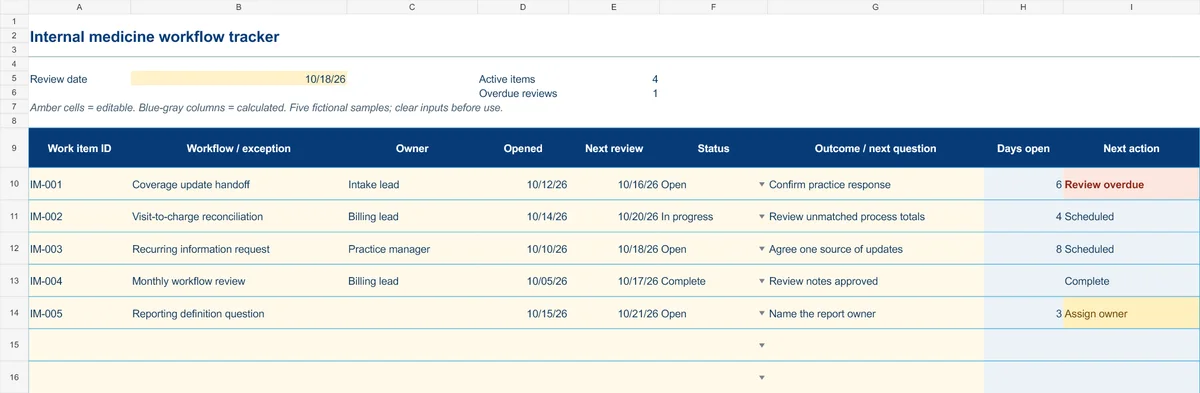
Start with the Instructions tab. Replace the five fictional samples, set your review date and keep the formula columns intact.
Free XLSX tool · No signup
Internal medicine workflow tracker
Coordinate recurring administrative exceptions, responsibilities and follow-up.
- 50 prepared operational work-item rows
- Opened date, next review and outcome notes
- Calculated days open and next actions
Use anonymous process tasks. Keep PHI in approved systems. Includes instructions and fictional samples; no macros or live data connection.