

Preserve the original source and version
Record the official notice or policy URL, the date reviewed and any effective information relevant to the practice. Distinguish an announcement about a future change from the instruction currently in effect.
Keep a controlled reference to the source rather than copying an excerpt without its context. When the source changes, retain enough history to understand which version informed a prior operational decision.
Assign an applicability reviewer
Name the person who determines which payer products, service workflows and locations are affected. That may require qualified clinical, coding or compliance input depending on the issue.
A coordinator can gather the notice and track questions but should not infer a universal rule from a short email. Record “needs review” where scope is uncertain, with a specific question and next owner.

Move from the question to the next action
Write the staff action in practical terms
Translate a confirmed change into the task staff actually perform. Identify the revised information requirement, route or escalation contact and who approves the instruction. Avoid distributing a long policy document without explaining which existing step changes.
Equally, avoid simplifying it so far that exceptions disappear. The instruction should point back to the official source and state the scope the practice reviewed.
Control the handoff to the team
Choose where current instructions live and how staff know which version to use. Update related checklists deliberately and remove obsolete copies through the practice’s normal process.
A briefing can use fictional examples to show the changed handoff without distributing patient records. Keep a record of unanswered questions and the approved interim route when staff encounter an exception that the new instruction does not resolve.
Schedule a review of the implemented change
Check a later sample for whether the instruction was followed and whether the expected information reached the next team. Separate process adoption from a promise about payment outcomes.
CMS coverage and authorization references are useful within their actual scope; payer-specific requirements still need direct review. The free register can assign anonymous change tasks, but it does not monitor websites automatically or establish compliance on its own.
Illustrative workflow
A practical example.
Fictional workflow: a notice reaches several inboxes and two staff members create different checklist edits. The manager records one official source, assigns an applicability review and approves one revised instruction. The old copies are retired through document control. A later sample checks whether staff used the new route, while a separate unresolved product question stays visible in the log.
Put it into practice
- Keep the official source, version and review date.
- Assign an explicit applicability decision.
- Link each revised instruction to its approved scope.
Inside the workbook
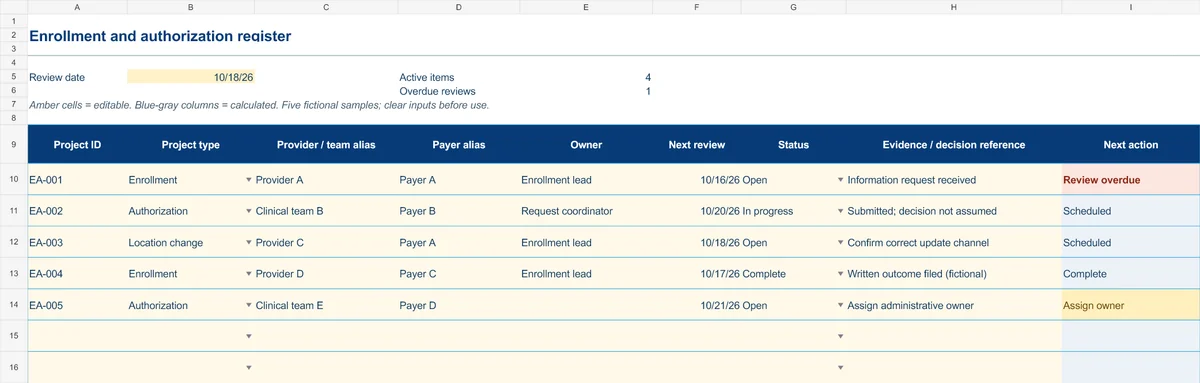
Start with the Instructions tab. Replace the five fictional samples, set your review date and keep the formula columns intact.
Free XLSX tool · No signup
Enrollment & authorization register
Track administrative projects from information gathering to a documented outcome.
- Project-type and status dropdowns
- Provider/team aliases and outcome references
- Calculated reminders for ownership and reviews
Use anonymous process tasks. Keep PHI in approved systems. Includes instructions and fictional samples; no macros or live data connection.