

Confirm what the record actually describes
Identify the service, setting and organizations involved from the approved source records. The presence of an imaging result in a chart does not establish the billing responsibility for every related activity.
Ask who can confirm the relevant service details and which organization maintains the supporting record. This map gives follow-up staff an appropriate starting point without assuming that a familiar workflow always has the same responsibility split.
State the component question precisely
If there is a question about professional, technical or other reporting responsibility, identify it explicitly for qualified review. Administrative staff should not infer the answer from a job title, a room location or a prior claim.
Preserve the record needed for the reviewer to assess the actual situation and document the authorized conclusion. A general article cannot determine which component a particular organization is entitled to bill.

Move from the question to the next action
Check applicable guidance and effective versions
CMS coverage and NCCI resources can be relevant to Medicare review. The responsible reviewer should establish the actual payer, service date and applicable document before using a policy or edit.
Other programs can have different requirements. Keep the source reference with the decision so later staff can understand what was reviewed, rather than turning an old successful claim into a permanent operational rule.
Separate a payer response from an internal mismatch
An outstanding balance may arise from missing information, an unresolved determination or payment-posting work. Read the actual response before routing it.
If the underlying organization or component responsibility has not been confirmed, resolve that administrative question first. Avoid sending a coder an unexplained balance or asking another organization to change its record without describing the specific evidence and question involved.
Keep the decision connected to future handoffs
Once responsibility is confirmed, update the approved workflow reference and notify the staff who use it. Preserve any limits on the conclusion; a decision about one arrangement does not automatically apply to every location or payer.
The internal medicine tracker can coordinate the operational follow-up with anonymous IDs. Detailed imaging and claim records belong in the appropriate authorized systems, with qualified review of each relevant billing determination.
Illustrative workflow
A practical example.
Fictional workflow: a practice receives a question about an imaging-related balance. The coordinator confirms the service setting and identifies which organization holds the supporting record. A qualified reviewer then assesses the actual component question using applicable guidance. The closeout records the outcome and the arrangement it applies to, so future staff do not generalize the answer to unrelated services.
Put it into practice
- Confirm the service, setting and responsible organization.
- Give component questions to qualified coding review.
- Record the scope and source of the authorized decision.
Inside the workbook
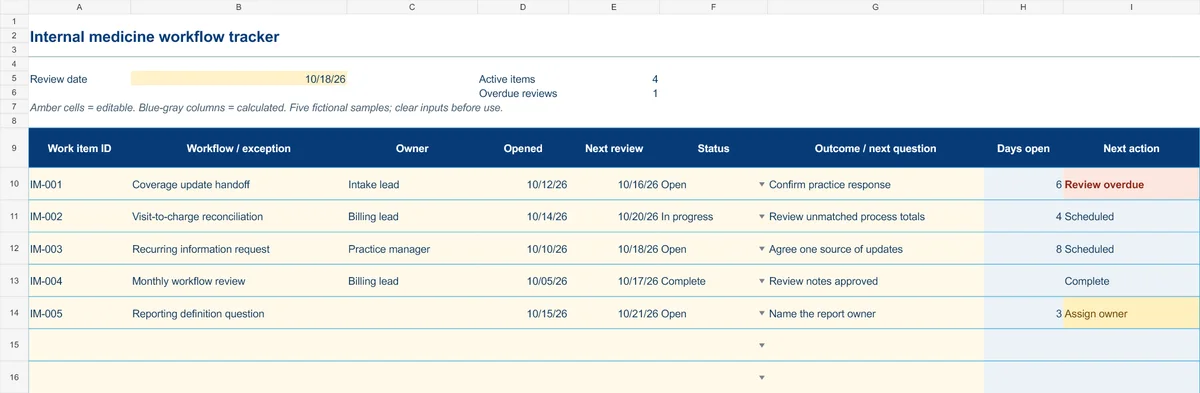
Start with the Instructions tab. Replace the five fictional samples, set your review date and keep the formula columns intact.
Free XLSX tool · No signup
Internal medicine workflow tracker
Coordinate recurring administrative exceptions, responsibilities and follow-up.
- 50 prepared operational work-item rows
- Opened date, next review and outcome notes
- Calculated days open and next actions
Use anonymous process tasks. Keep PHI in approved systems. Includes instructions and fictional samples; no macros or live data connection.