

Define an administrative exception
Agree what belongs in the feedback review: incomplete routing information, an unclear provider record or an unanswered billing query. Keep urgent patient concerns in the practice’s clinical process.
A billing tracker is not a triage system, and an administrative priority should not determine how a patient receives care. This boundary helps staff understand which questions they can coordinate and which must immediately reach the designated clinical team.
Preserve the point where information was lost
Record the source stage, the detail requested and the handoff that did not supply it in the authorized system. Avoid broad labels such as “front desk error” before checking the actual sequence.
Staff may have collected the information correctly but lacked a reliable route to billing. Understanding the event is more useful than assigning blame from the final payer response alone.

Move from the question to the next action
Route visit and coding questions appropriately
The service record should reach the people responsible for documentation and billing review. Appointment labels or operational counts do not establish the correct reporting of a visit.
Qualified reviewers can consult applicable guidance, including CMS E/M resources for relevant Medicare services. The intake feedback process should identify a review need, not instruct reception to select a code or add documentation for reimbursement.
Create a small, usable feedback sample
Choose a defined period and examine a manageable set of recurring exceptions. Keep the population and source visible so the team does not generalize a few items to every shift.
Ask which process change would have prevented the missing handoff: a clearer field instruction, one response contact or a confirmation step. Give that change an owner and an agreed review method.
Check whether the process changed
At the next review, examine whether staff used the revised route and whether the same unanswered question still occurs. Separate process adoption from payment outcomes.
The primary care checklist can organize anonymous administrative checks across intake and billing, while patient and claim details remain in approved systems. Retain exceptions that still require a decision; removing them from a dashboard does not resolve the underlying work.
Illustrative workflow
A practical example.
Fictional workflow: billing repeatedly lacks a practice contact for a visit-information question. Sampling shows that reception completed its part but the request went to a shared inbox with no assigned owner. The manager defines one response role and a backup. The next sample checks whether questions receive an accountable recipient, while all clinical concerns continue through the practice’s existing escalation process.
Put it into practice
- Keep clinical escalation separate from billing feedback.
- Trace the actual handoff before naming a cause.
- Test a specific process change on a later sample.
Inside the workbook
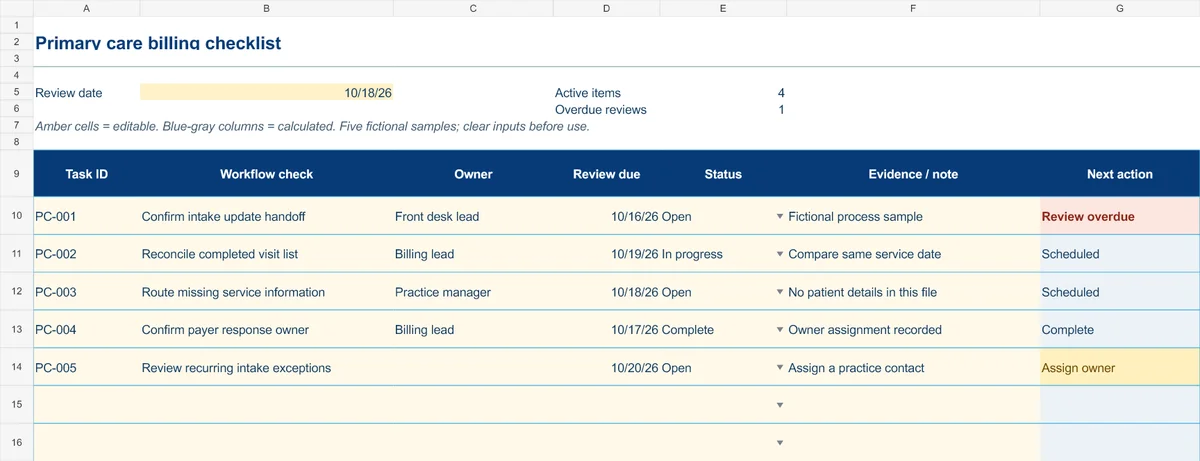
Start with the Instructions tab. Replace the five fictional samples, set your review date and keep the formula columns intact.
Free XLSX tool · No signup
Primary care billing checklist
Daily process checks across intake, encounter reconciliation and payer follow-up.
- 50 prepared task rows and five fictional examples
- Owner, review date, status and evidence notes
- Calculated next-action reminders
Use anonymous process tasks. Keep PHI in approved systems. Includes instructions and fictional samples; no macros or live data connection.